Pink Jumper Sparks MAGA Outrage, Questions Masculinity
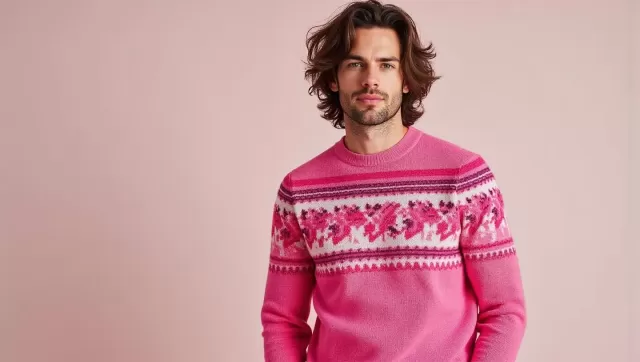
A seemingly ordinary men's sweater from the classic American retailer J. Crew has become the unlikely epicenter of a heated online debate, leaving many onlookers puzzled. The garment itself is a study in conventional design: a wool, crew-neck pullover featuring a traditional Fair Isle pattern around the shoulders. It lacks any of the avant-garde elements that typically provoke fashion discourse—no unusual cuts, no bold slogans, no overt political statements. The single feature causing this commotion is its color: a soft, heathered pink.
An Online Uproar Over a Single Color
The controversy gained significant traction following a social media post by conservative commentator Juanita Broaddrick, who questioned whether men would actually wear the $168 piece. The response from her followers was swift and overwhelmingly negative, though the price was rarely the main objection.
The comments revealed a deep-seated rejection of the color for menswear. One user declared that no man in her family would ever wear it, while another noted her husband's aversion extends even to pink towels. The criticism quickly escalated, with some linking the sweater to sexuality and femininity, one user emphatically stating he was "a man, not gay" and wouldn't be dressing like a character from a classic female-led sitcom. A Republican congressman from Tennessee even likened the sweater to something a college student in a sorority might have worn decades ago, a comparison meant as a sharp critique.
The Political Weaponization of a Sweater
For many critics, the pink jumper was not just a fashion misstep but a symbol of political and cultural decay. Opponents began associating the garment with liberal ideologies, with one user suggesting it would be the uniform at protests against U.S. Immigration and Customs Enforcement. Another sarcastically remarked he'd only wear it for an "undercover" operation among supporters of the Democratic party. The sentiment was visually captured when one individual digitally altered a product image, replacing the model's head with that of California's Democratic governor, Gavin Newsom.
This reaction is particularly noteworthy given J. Crew's established brand identity. The label is synonymous with preppy style, an aesthetic historically aligned with the traditional, establishment right. Author Maggie Bullock, in her book on the brand, defined prep as the foundation of classic American style. The current backlash highlights a growing fracture within conservative circles, pitting the old-school preppy look against the more aggressive cultural stance of the modern MAGA movement.
Pink's Complex and Shifting History in Fashion
While the outrage is palpable, it overlooks the fluid history of pink in clothing. We live in an era where male celebrities known for their bold fashion choices, like Harry Styles and Tyler, The Creator, have embraced the color. It has also been worn by more conventional figures such as Jake Gyllenhaal and even Daniel Craig. Furthermore, the notion of pink being inherently feminine is a relatively recent development.
Go back a century, and you'll find a completely different standard. A 1918 trade publication, for instance, advised that pink was a better choice for boys due to it being a "stronger" color, while the more "delicate" blue was deemed more suitable for girls. The modern, rigid gender association with these colors largely evolved from marketing decisions related to children's apparel. The irony is that even prominent right-wing figures, including Donald Trump and Nigel Farage, have frequently worn pink ties without anyone questioning their self-professed authority.
Masculinity and the Meaning of a Pullover
The intense hand-wringing over the J. Crew sweater points to a deeper anxiety surrounding the state of contemporary American masculinity. The central contradiction, however, is that any version of masculinity so easily threatened by a colored piece of yarn is likely far more fragile than its proponents would ever admit.
While the brand is certainly receiving a wave of unexpected publicity from the affair, it's doubtful this was a calculated move. Unlike other retailers that have appeared to intentionally stoke controversy for brand visibility, J. Crew's decision seems far more innocent. It is more plausible that the designers simply saw a pink Fair Isle sweater as a stylish, seasonal offering and did not anticipate it would become a flashpoint in a culture war. Because, in the end, that is all it is: a sweater.